
Documentation is the backbone of accessibility, traceability, and compliance of any ISO Certification. It ensures that employees can find the right information and standard processes to perform tasks without confusion. A Well-structured documentation system helps organizations establish a clear line of action and decisions. As a result, it makes it easy for organizations to trace issues back to their roots and ensure conformity. Proper documentation provides objective evidence that requirements are being met. In short, documentation turns processes into measurable, controlled, and continuously improving systems. ISO provides organizations with a comprehensive framework that turns documents from a compliance burden into a reliable operating tool. Why ISO Documentation Works? ISO standards, such as ISO 9001, ISO 14001, and ISO 45001, have shifted away from rigid templates and toward the concept of documented information. It focuses on all the documentation requirements an organisation needs to operate effectively to show conformity. ISO requires control and evidence; hence, a one-size-fits-all approach does not apply. Organizations must keep what’s necessary to ensure their availability to the right people at the right time. When documents are intentionally concise, clearly labelled, and linked to processes, they become effective tools, not hidden liabilities. The Foundation of ISO Documentation: The Three Key Pillars 1) Accessibility ISO mandates documented information to be available and protected. It requires an organization to maintain consistent file naming, ownership, and centralized storage in digital repository systems. As a result, when teams can find the latest procedure or work instruction in two clicks, mistakes and delays drop sharply. 2) Traceability Traceability is about linking the dots from requirement, design, production, test, release, and record. ISO requirement clauses, such as identification and traceability. Hence, it makes it explicit that products, components, or process outputs have clear identifiers and a documented history. Organizations use tools to ensure traceability and cut mean-time-to-respond when recalls, defects, or compliance questions arise. 3) Compliance The ISO standard approves a document to ensure that revisions are issued and obsolete documents are removed from records. Clause 7.5 of ISO 9001 and related guidance explain that controlled documented information demonstrates effective planning and operational control. Implementation of ISO Documentation It creates a process map and tags the documented information required for each step. As a result, it keeps the documentation list short, including policies, core procedures, critical work instructions, and records. A naming convention plus version to prevent history “which is the latest” chaos. Hence, it helps in treating superseded documents as archives, not deleted files. Wherever possible, link to authoritative sources (SOPs, forms, technical specs) rather than duplicating text. As, it keeps updates simple and traceability intact. Simple workflow tools help organizations stop documents from sitting in inboxes and ensure approvers sign off in order. Conclusion ISO compliance becomes stressful and costly when documentation is unorganised or outdated. However, when documents are easily accessible, traceable, and well-controlled, they become a business strength. Audits become smoother, risks are reduced, and teams work more efficiently and with greater confidence. An organization can support growth with the right structure and expert guidance to maintain documentation.
How ISO Structures Documentation to Improve Accessibility, Traceability, and Compliance?
One of the biggest challenges organisations face during the ISO Certification process is understanding the complex documentation process. Many organisations see documentation as a pile of papers filled with intricacies and complexities. However, organisations can take advantage of ISO Consulting services to understand and comply with ISO Certification requirements. ISO consultants can turn documentation burdens into strategic assets by leveraging their industry- and standards-related expertise. As a result, they help you adopt a proper documentation process to boost accessibility, strengthen traceability, and simplify compliance. Why Documentation Becomes a Pain Point for Businesses? Organisations always strive to make a greater impact on clients and users. However, in the process, they often do not address the elephant in the room: adopting structured documents to ensure smooth documentation. The major pain points organisations come across during their ISO certification journey are: Where is the latest SOP or updated file? Who approved this change? We do the work correctly, but why can’t we prove it? Is our team not following the process? Why do audits feel like treasure hunts without the treasure? How do ISO consultants help organisations adopt the Structure Documentation process? ISO documentation follows a pyramid-like structure to make the entire process easier for businesses. The structure is as follows: ISO standards enable organisations to implement a comprehensive, structured documentation process to prevent chaos and confusion. It helps businesses maintain proper registers, naming conventions, version numbers, and digital systems. As a result, it saves guesswork and frustration while ensuring smooth operations across different departments. Traceability in business ensures that the organisation adopts proper measures to track every step of the product, service, or process. It works on the principles of – What happened? When it happened? Who did it and why? It is equally important for businesses of all sizes to address and manage customer complaints, machine maintenance, and product non-conformities. However, these small measures play a significant role in the audit process, as they smooth the audit process by saving time and costs. ISO standards promote a risk-based approach to ensure compliance with ISO certification requirements. On the other hand, the structured documentations help businesses in: Identified risks Preventive controls Corrective actions Monitoring mechanisms ISO Certification enables organisations to maintain consistency by reducing interpretation errors and uniformity across departments. It also helps organisations to integrate bulky manual files for a smooth and easier documentation process. How ISO Consultancy Services Help Organisations in the Certification Process? ISO Consultants help organisations in the following ways: Map all your business processes. Develop a clean documentation structure. Create policies, procedures, workflows, and templates. Implement document control systems. Train your team for long-term continuity. Prepare for certification and surveillance audits. Maintain compliance year after year. ISO Consulting helps businesses simplify, make accessible, and ensure audit-friendliness and future-proof their entire documentation process. Conclusion ISO consultancy offers a systematic and structured documentation process to provide clear, concise, and controlled documentation for organisations. It also enables businesses to implement organised documentation to establish traceability and accessibility.
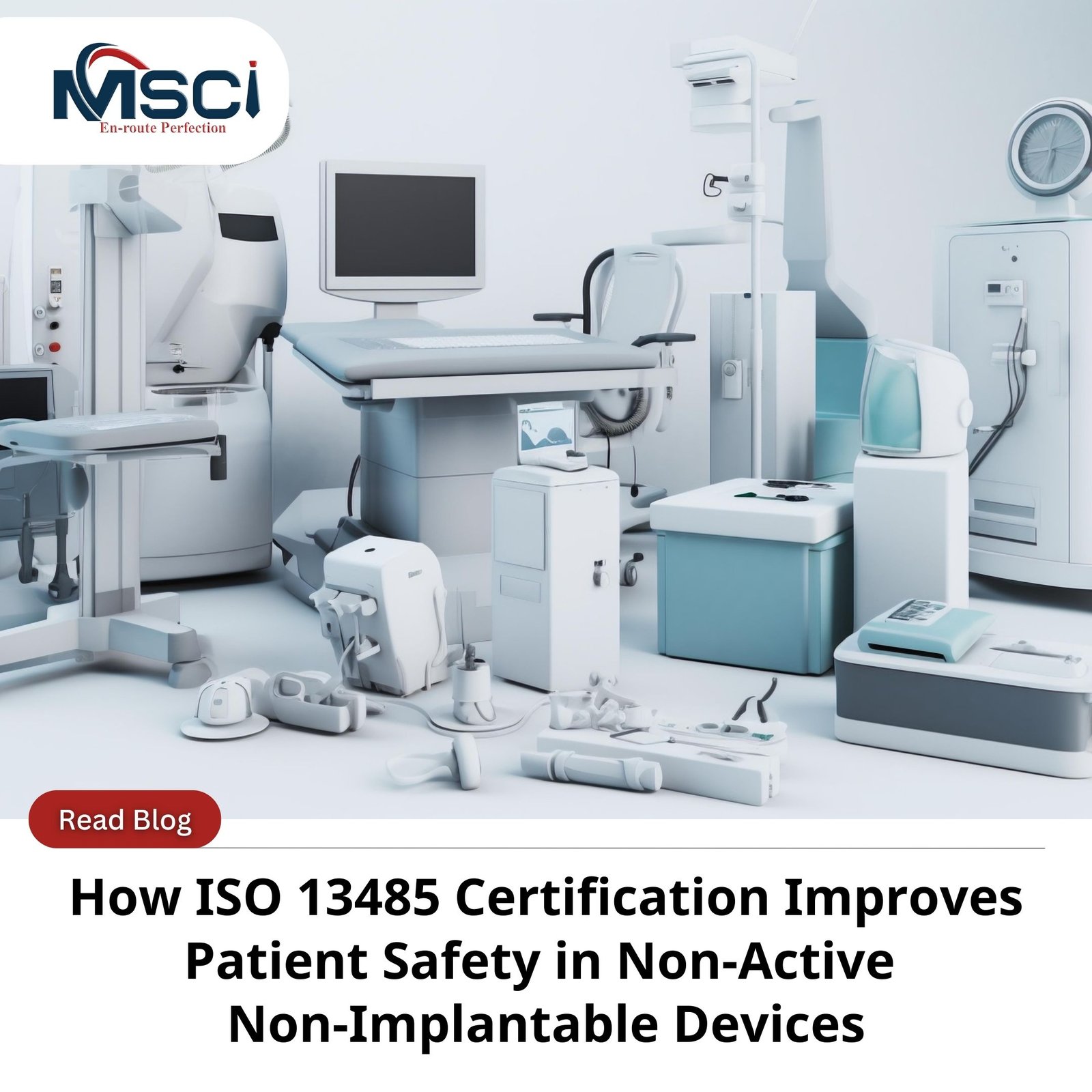
How ISO 13485 Certification Improves Patient Safety in Non-Active Non-Implantable Devices?
When it comes to medical devices, “good enough” is never good enough when people’s health and lives depend on them. Even non-active, non-implantable devices, which may seem low-risk compared to complex implantable or active devices, play a critical role in patient care. Surgical instruments, hospital beds, wound dressings, bandages, and catheters may not require batteries to function, but their safety, quality, and reliability are just as crucial. However, ISO 13485 Certification is the gold standard for quality management in the medical device industry. And if you’re wondering how it improves patient safety and how ISO consultants help you achieve it, you’re about to find out. Understanding ISO 13485 and Non-Active Non-Implantable Devices ISO 13485 is an internationally recognised quality management system (QMS) standard specifically designed for medical devices. It aligns with the regulatory requirements of multiple markets, including the EU, US, Canada, and beyond. Non-active, non-implantable devices are those that: Do not require power (electrical, mechanical, or any other energy source) to function. They are not intended for long-term use in the human body. Examples include: Surgical scissors and scalpels Stethoscopes Hospital stretchers Tongue depressors Thermometers (non-digital) Wound dressings and gauze While they may appear simple but any defect in these products, such as contamination, sharp edge malformation, or poor material quality, can cause injury, infection, or delayed recovery. How ISO 13485 Improves Patient Safety? ISO 13485 requires manufacturers to implement rigorous quality control procedures at every stage, from design, material sourcing, production, packaging, and distribution. It also includes materials for wound dressings that must be sterile and hypoallergenic, and surgical tools must meet precise sharpness and durability standards. ISO 13485 requires risk assessment at each level of the device life cycle. This means identifying hazards such as contamination, sharp edges, and toxic materials. Evaluating the severity and probability of harm and implementing controls to eliminate or minimise risks For example, when a manufacturer produces stainless steel forceps, these steps ensure ISO 13485 processes check for material defects and surface cleanliness before shipment, significantly reducing the risk of post-surgical infections. ISO 13485 requires full traceability in the event of issues arising. Each batch is traced to production records, suppliers, and materials. This traceability enables: Quick recalls to prevent further patient harm Root cause analysis to prevent repeat issues Patient safety is not a one-time checkbox; it’s an ongoing commitment. ISO 13485 requires regular audits, management reviews, and corrective and preventive actions (CAPA) to ensure compliance. As a result, this ensures that any issues, whether identified internally or through customer feedback, are addressed swiftly and effectively, creating a cycle of ongoing safety enhancements. Why ISO 13485 is Critical for Non-Active Devices? Many businesses mistakenly believe that non-active devices face less regulatory scrutiny. In truth, both regulators and hospitals demand the same rigorous quality assurance for these products as they do for sophisticated, active devices. This standard is critical for several reasons: Non-active devices frequently come into direct contact with patients, such as bandages and surgical instruments. Many are deployed in sterile environments, where even minor contamination can have serious consequences. Just one defective device can lead to lawsuits, costly recalls, and lasting damage to your brand’s reputation. Role of an ISO 13485 Consultant in Achieving Certification Achieving ISO 13485 certification is not a fill out a form and wait for approval process but a detailed, compliance-heavy journey. This is where ISO Certification Consultants add immense value. Gap Analysis – Consultants assess your current operations against ISO 13485 requirements to identify what’s missing. For example: Are your production records complete? Are supplier evaluations documented? Are your sterilisation procedures validated? Documentation Support – ISO 13485 demands extensive documentation from risk management files to process validation reports. Consultants help prepare and organise these documents so they meet auditor expectations. Process Optimisation – ISO certification isn’t just about compliance but efficiency. ISO consultants streamline workflows so quality processes become part of daily operations rather than an extra burden. Training Your Team – A Medical Devices – Quality Management System is only as strong as the people following it. As a result, ISO 13485 MD-QMS Consultants provide ISO 13485 awareness training so employees understand why these processes matter and how to follow them correctly. Audit Preparation – ISO certification audits can be intense. Consultants conduct mock audits to prepare you for the real thing, identifying weaknesses before the official assessment. Conclusion In the medical device world, whether active, non-active, implantable, or non-implantable, patient safety is non-negotiable. For non-active, non-implantable devices, ISO 13485 certification ensures that every bandage, forceps, or surgical tray meets the highest quality and safety benchmarks. With the guidance of experienced ISO 13485 consultants, navigating the complex certification process becomes less daunting, more efficient, and more rewarding. When lives are at stake, almost safe simply isn’t safe enough. ISO 13485 helps you bridge the gap between good intentions and guaranteed safety, one quality-controlled device at a time.
Discover the Best ISO Certification Consultants in UAE: Dubai, Sharjah & Abu Dhabi
Looking to gain a competitive edge in the UAE market? Start with ISO certification, and no, not just any certification, but one that reflects the quality, security, and trust your business offers. Here’s your complete guide to choosing the top ISO certification consultants in the UAE, including Dubai, Sharjah, and Abu Dhabi. Why ISO Certification in UAE Matters More Than Ever? The UAE, with its pro-business infrastructure and growing emphasis on international quality standards, has become a hub for innovation, manufacturing, trade, and services. Whether you are a startup in Sharjah, a logistics giant in Dubai, or an IT firm in Abu Dhabi, ISO certification in the UAE is more than a badge but a business necessity. ISO certification strengthens an organisation’s reputation in the market by ensuring regulatory compliance and improving internal efficiency. However, ISO Consultancy Services in the UAE helps businesses win new contracts, especially in government and international sectors, by enabling them to adopt local and global best practices. ISO Certification process can be overwhelming if you don’t have the proper guidance, and that’s where ISO certification consultants in Dubai and across the UAE come in. What Do ISO Certification Consultants in Dubai and the UAE Do? ISO certification consultants in Dubai and the UAE guide businesses through the entire ISO certification process, from selecting the suitable standard to final audit readiness. ISO Consulting services in Dubai assess existing operations, identify gaps, implement compliant management systems, and train staff to meet ISO requirements. Expert ISO Consultants have industry-specific as well as region-specific knowledge of various ISO Certifications, including ISO 9001:2015 Certification, ISO 14001:2015 Certification, and ISO/IEC 27001:2022 Certification. ISO Certification Consultancy Services in UAE ensure that the business processes are efficient, cost-effective, and aligned with local UAE standards. In short, they turn ISO from a box-ticking exercise into a genuine business improvement strategy. Role of ISO Certification Consultants in UAE: Dubai, Sharjah & Abu Dhabi ISO consultancy firms are not the certifying bodies. They don’t issue the certificate. What they do is guide businesses from chaos to compliance without the jargon and bureaucracy. Benefits of Hiring the right ISO Certification Consultant in UAE ISO 9001:2015 is the Most Demanded ISO Certification in UAE ISO 9001 is the gold standard for Quality Management Systems (QMS). Companies across manufacturing, healthcare, logistics, and even tech firms are chasing this certification. Benefits of ISO 9001 certification in UAE include: If you’re planning to get ISO 9001 certification in Dubai, Sharjah, or Abu Dhabi, working with experienced consultants will dramatically reduce time and effort while increasing your success rate. Choosing the Top ISO Certification Consultants in UAE Not all consultants are created equal. Some are freelancers with a one-size-fits-all model, while others, like full-service consultancy firms, offer tailored, hands-on guidance. Here’s how to identify the top ISO certification consultants in UAE: Proven Experience Across Industries Local Presence with Global Understanding Transparent ISO Certification Consultancy Services Cost in UAE ISO Certification Consulting Services in Sharjah and Abu Dhabi While Dubai leads the business narrative, ISO certification consultants in Sharjah and ISO certification experts in Abu Dhabi are making serious strides. Sharjah is known for its manufacturing and academic sectors, the best ISO certification in Sharjah is typically focused on ISO 9001:2015 Certification for Quality Management System (QMS) Sharjah, ISO 14001:2015 Certification for Environmental Management System (EMS) in Sharjah, and ISO 45001:2018 Certification for Occupational Health and Safety Management System (OHSMS) Sharjah. Local consultants offer on-site audits and implementation support tailored to industrial compliance needs. Abu Dhabi with its energy, aviation, and infrastructure-heavy economy, ISO certification in Abu Dhabi often leans toward ISO/IEC 27001:2022 Certification for Information Security, Cybersecurity and Privacy Protection — Information Security Management System (ISMS) in Abu Dhabi and ISO 50001:2018 Certification for Energy Management System (EnMS) in Abu Dhabi. Consultants here also help with government-related contracts that demand strict ISO compliance. Conclusion ISO certification is more than a checkbox but a strategic move to elevate your operations and market credibility. With numerous consultants in Dubai, Sharjah, and across the UAE, the key lies in selecting a partner who understands your business, guides you through every phase, and delivers tangible value. Organisations should not fall for flashy promises or one-size-fits-all solutions. However, choosing experienced consultants who bring expertise, integrity, and long-term support can be a real game-changer. When done right, ISO certification isn’t just paperwork but a long-term business investment. So, why settle for compliant when you can be competitive? Let’s get started.
Common ISO Compliance Mistakes and How to Fix Them
Common ISO Compliance Mistakes and How to Fix Them Do you think ISO certifications guarantee long-term compliance? Think again. ISO Certification is an effective marketing tool. Many businesses proudly display their ISO certificates to enhance their credibility and reliability in the highly competitive market. Organizations burn their midnight oil when it comes to maintaining internal management systems and building an efficient team. The reality is that non-compliance isn’t always about major failures but often small mistakes. Companies overlook mistakes that snowball into audit red flags, lost certifications, and even reputational damage. So, what are these common pitfalls? And, more importantly, how can you fix them before they derail your operations? 1. Lack of Leadership Commitment Effective leadership backing is crucial for any ISO rollout. When upper management treats certification as a “nice-to-have”, the initiative stagnates, and the purpose of adopting ISO Certifications fails. Lack of leadership is one of the most common ISO 9001 non-compliance risks. How to fix it: Secure a senior executive sponsor to champion ISO initiatives. Have them routinely review quality, security objectives, audit outcomes, and resource allocation for effective implementation. Businesses can demonstrate leadership involvement through effective communication systems and training sessions to empower employees. 2. Poor Documentation & Over-Documentation Organizations face non-compliance issues due to missing documents, outdated practices, or documents buried under piles of unnecessary paperwork. ISO demands precision, not verbosity. Too much documentation can often lead to confusion, while too little can result in non-compliance. How to fix it: Create essential procedures, policies, and templates only. Implement adequate management system control tools to manage revisions and identify changes. Companies must regularly review documents for clarity, conciseness, and adherence. 3. Neglecting Risk-Based Thinking Organizations often overlook risk registers and treat risk management as a mere checkbox, which undermines the credibility of ISO. Many organizations ignore this and fail to integrate simple risk assessments into their operations. How to fix it: Companies are required to perform thorough risk assessments for all processes and assets. Study risk matrices, such as those that compare impact versus likelihood, to prioritize various potential risks. Update risk registers continuously and link them to control measures. 4. Inadequate Internal Audits & Reporting Skipping or rushing internal audits leads to surprise non-conformities during external audits. Ignored Non-Conformance Report (NCR) logs and weak corrective actions compound the issue and act as a hurdle in the ISO Certification process. How to fix it: Schedule internal audits to ensure clear coverage of all clauses. Log NCRs centrally and assign corrective action owners and deadlines. Review open NCRs during management reviews to escalate non-conformities and shortcomings. 5. Insufficient Employee Training & Awareness Training is often irregular or too superficial; everyone knows ISO, but only a handful of people are aware of its complexities and intricacies. Employees who are unaware of their ISO responsibilities contribute to non-compliance and a breakdown in culture. How to fix it: Companies need to build a training matrix to map roles to required ISO knowledge. Deliver engaging and continuous training sessions, but avoid dry lectures. Reinforce learning with posters, newsletters, and drills. 6. Resistance to Change & Overcomplicating the QMS Teams often bury their heads at the mere mention of “new processes.” However, too little information can lead to confusion and fear among employees and the management system. How to fix it: Communicate why change is needed—benefits, not burdens. Keep systems lean: only necessary processes, no bloated manuals. Pilot changes, solicit feedback, then scale. How to Fix ISO Compliance Issues? Step What to do Leadership Workshop Kick off with executive training—commitment is your foundation. Gap Analysis Compare current systems against ISO clauses. Identify high-risk gaps. Risk Planning Create risk registers. Assign mitigation owners and timelines. Lean Documentation Write crisp policies/procedures with version history and traceability. Training & Awareness Launch role-based programs, awareness campaigns, and quizzes. Audit Schedule Plan internal audits, assign auditors, close NCRs transparently. Management Review Use dashboards that surface KPIs, audit results, and risks. Continuous Improvement Apply PDCA—Plan-Do-Check-Act. Monitor, adjust, repeat. For ethical reasons, certification bodies can’t provide consulting services, so you’ll need both an ISO consultant and a certification body in your ISO journey. Avoiding common ISO compliance mistakes saves time, money, and migraines. Done right, ISO certification becomes a strategic growth lever—not just a certificate on the wall. Leadership alignment, streamlined documentation, effective risk management, and continuous improvement are non-negotiable. If you’re ready to plug these gaps—and turn ISO from headache into asset—talk to us today. Our seasoned consultants specialize in ISO 9001, ISO/IEC 27001, and end-to-end support across CISOs, startups or legacy manufacturers. Let’s fix those mistakes and build quality that lasts.
How to Choose the Right ISO Consultant in the United States of America (USA)?
How to Choose the Right ISO Consultant in the United States of America (USA)? ISO certification is a game-changer for businesses in the United States, aiming to enhance credibility and meet compliance requirements. However, navigating the complexities of ISO standards can be overwhelming without expert help. That’s where an ISO certification consultant comes into play. But with so many options, how do you choose the right one? This guide will walk you through everything you need – from understanding ISO consultancy services in USA to comparing costs. As a result, you can choose the right consultants based on your specific industry needs and requirements. Understanding ISO Certification Consultancy Services ISO certification consultants guide businesses through the complete certification process-from planning and documentation to audits and training. The main goal of the ISO Certification Consultancy firm is to ensure an organization meets the standard requirements without any non-conformities. A skilled consultant doesn’t just help you “tick the boxes.” They tailor ISO systems to meet the needs and requirements of your organizational operations to achieve lasting improvements in quality, safety, and environmental performance. Role of ISO Consultants in Addressing These Implications ISO Consulting Services help organizations navigate the complex requirements of the Digital Personal Data Protection (DPDP) Act. ISO/IEC 27001 ISMS consultants assist businesses align with structured risk assessments to adopt data security frameworks and compliance strategies. ISO Consultancy Services vs. ISO Certification Services It’s essential to know that ISO consultants and certification bodies are not the same.Here’s how they differ: Service ISO Consultancy Services ISO Certification Body Role Provides guidance and implementation Conducts audits and issues certification Scope Internal audits, gap analysis, training Final certification audit only Authority Cannot issue certificates Must remain independent For ethical reasons, certification bodies can’t provide consulting services, so you’ll need both an ISO consultant and a certification body in your ISO journey. Why Businesses in the USA Need Specialized ISO Certification Guidance? Every region has its regulatory nuances, and the USA is no exception. An experienced ISO Certification consultant in the USA understands local compliance, Health, Safety and Environment (HSE) regulations, and industry-specific challenges. Whether you are a startup in Texas or a manufacturer in Ohio, Management System Compliance Incorporation (MSCi) consultants offer comprehensive support that consultancy firms might miss. What Does an ISO Certification Consultant Do in the United States of America (USA)? ISO Consultants in the USA help organizations comprehend the complex standard requirements to prepare adequately and ensure proper implementation. Silicon Valley, in northern California, is known for its innovation and technology. Finding an expert consultant in California can help companies expand their operations and get new opportunities. Role of an ISO Certification Consultant in the USA Expert ISO 21001 EOMS Consultant in New York helps educational institutions implement necessary practices and teaching methodologies to create more student-centric classrooms. Likewise, an ISO Consultant in the USA offers intensive training and workshops on standard requirements to help them prepare the required documentation and effectively implement them. Hence, organizations can reduce their efforts, time, and resources by hiring an experienced professional to guide them through the process. ISO 9001 QMS consultancy services in the USA help businesses build a quality management system to improve resource utilization and internal processes. ISO consultant in the United States observes an organization’s internal operations to check compliance with quality guidelines. They help organizations conduct gap analysis and internal audits to identify areas with shortcomings. Similarly, ISO 14001 Environmental Management System (EMS) Certification Consulting Services in the USA helps organizations prepare the necessary documentation to implement appropriate environmental controls. Benefits of Hiring an ISO Certification Consultant for Organizations in the USA Hiring a consultant can significantly shorten the ISO standard process timeline in the USA. Without guidance, it might take up to a year. However, a consultant can help organizations achieve certification in the shortest timeframe, depending on the standard and readiness level. The following are the advantages of hiring an expert ISO Certification Consultant in the USA. These are: ISO standards require detailed documentation, including policies, procedures, manuals, and records. However, an expert ISO consultant ensures that the organization in the USA are well-structured and audit-ready by offering customized support and guidance. ISO Certification Consultancy Services in the USA help organizations identify potential non-conformities before the final audit. The proactive approach prevents unforeseen events and strengthens your chances of passing the certification on the first attempt. Consultancy Services don’t just implement; they empower the workforce. They help organizations organize workshops and training sessions to prepare stakeholders and employees for long-term compliance and internal audits. Conclusion ISO Certification Consultants not only have a deeper understanding of various standard requirements. However, they help organizations across diverse sectors understand and implement appropriate measures. There is a very thin line difference between ISO Certification Services and ISO Certification Consultancy Services. Hence, opting for consulting services in the USA can help organizations save extra time, resources, and effort.
India’s New Data Law: Is Your Business Ready?
India’s New Data Law: Is Your Business Ready? In August 2023, the Indian Parliament enacted the Digital Personal Data Protection (DPDP) Act, marking a significant milestone in the nation’s approach to data privacy. This legislation emerged after extensive deliberations spanning over five years to reflect India’s commitment to safeguarding personal information in an increasingly digital landscape. Key Features of the DPDP Act The Digital Personal Data Protection (DPDP) Act introduces several pivotal provisions :- Data Localization: The Act reinstates requirements for data localization to mandate that certain types of personal data remain within India’s borders. Hence, this measure aims to enhance data security and sovereignty. Parental Consent for Minors: Individuals under 18 years of age are now required to obtain parental consent to access social media platforms. As a result, this provision seeks to protect minors from potential online risks. Regulatory Oversight: The establishment of a committee to determine permissible data processing activities for significant data fiduciaries, including major technology firms. It reflects the government’s intent to exercise stringent oversight over personal data management. What are the Implications of New Data Protection Regulation for Organizations in India? The Digital Personal Data Protection (DPDP) Act, 2023, introduces stringent compliance requirements for organizations handling personal data. Businesses across industries must reassess their data collection, processing, and storage mechanisms to ensure alignment with the new legal framework. However, any failure to comply could lead to hefty penalties, reputational risks, and operational disruptions. Here are the key implications :- Data Localization Requirements – Certain types of personal data must be stored within India, impacting businesses that rely on cross-border data transfers. Organizations must invest in localized data centers to secure cloud solutions and geo-restriction technologies. Stronger User Consent Mechanisms Explicit consent is mandatory before processing personal data. It means businesses must revise privacy policies, user agreements, and consent forms. Organizations need transparent and easy-to-understand data collection practices to avoid regulatory scrutiny. Enhanced Data Security Measures Businesses must implement stronger encryption to access controls and cybersecurity protocols to prevent data breaches. Failure to protect sensitive information can lead to substantial financial penalties and legal consequences. Regulatory Audits and Accountability Companies classified as Significant Data Fiduciaries (SDFs) will face more frequent audits and compliance checks. They must establish internal data protection frameworks to appoint Data Protection Officers (DPOs) and maintain compliance records. Impact on Third-Party Vendors and Supply Chains Organizations need to ensure third-party service providers (e.g., cloud hosting, SaaS platforms) adhere to the same data protection standards. Vendor contracts must be updated with strict data processing agreements to mitigate compliance risks. Role of ISO Consultants in Addressing These Implications ISO Consulting Services help organizations navigate the complex requirements of the Digital Personal Data Protection (DPDP) Act. ISO/IEC 27001 ISMS certification consultants assist businesses align with structured risk assessments to adopt data security frameworks and compliance strategies. How ISO Consulting Firms Enable Companies in India to Navigate Data Protection Regulations? In this evolving regulatory environment, ISO consulting firms play a crucial role in assisting organizations across various industries to achieve and maintain compliance with data protection laws. These firms provide structured frameworks for managing information security and privacy. Services Offered by ISO Consultancy ISO consulting firms offer a comprehensive suite of services to support organizations in their data protection endeavours: Gap Analysis and Risk Assessment : ISO Consultants evaluate current information security practices against ISO standards to identify areas of non-compliance and potential risks. Policy Development and Implementation : ISO Consulting Services assist organizations in formulating and deploying information security policies and procedures to comply with both organizational objectives and regulatory requirements. Employee Training and Awareness Programs : Consultants conduct sessions to educate staff on data protection principles. Hence, it fosters a culture of security awareness within the organization. Internal Audits and Compliance Monitoring : ISO Consultancy performs regular audits to assess the effectiveness of the ISMS and ensure standard adherence. Conclusion The introduction of the Digital Personal Data Protection (DPDP) Act represents a transformative shift in India’s data protection landscape. Organizations must proactively adapt to these changes to ensure compliance and maintain stakeholder trust. ISO consulting offer their expertise and resources necessary to navigate the complexities of data protection regulations effectively.
How does an ISO/IEC 27001 Consultant help Information Technology (IT) Companies to understand Data Security Protocols?
How does an ISO/IEC 27001 Consultant help Information Technology (IT) Companies to understand Data Security Protocols? As of February 2025, approximately 5.56 billion people worldwide are internet users, representing 67.9% of the global population. It shows that the amount of data created and stored has increased significantly. As a result, organizations must implement a resilient framework to safeguard data from cyber-attacks and breaches. ISO/IEC 27001 is a universally recognized standard for Information Security, Cybersecurity and Privacy Protection — Information Security Management System (ISMS). The standard provides a structured framework for organizations across various industries to safeguard sensitive data. What is Data Protection? Data protection measures enable organizations to safeguard sensitive information against loss, unauthorized access, tampering, or corruption. Data protection protocols help Information Technology (IT) companies prevent confidential and sensitive data from being corrupted, compromised, or lost. Data protection ensures that information is only accessible for permitted uses and the organization complies with all applicable legal or regulatory requirements. Three Pillars of Data Protection Data protection and information security regulations enable organizations to protect sensitive data from unauthorized access, loss, or corruption. Moreover, it also ensures that the information remains accessible when needed by focusing on the three principles of information security. These are: Confidentiality: It restricts data access to authorized personnel only. Integrity: It aims to preserve data accuracy and prevent unauthorized modifications. Availability: It ensures data is accessible whenever required. Why do Organizations in the Information Technology (IT) Sector Need an Information Security Management System (ISMS)? ISO/IEC 27001:2022 for information security and privacy offers a comprehensive risk-based approach for IT companies to assure data protection. It also enables an organization to identify and address potential threats to meet modern security needs. In technical terms, going for ISO 27001 certification consultancy services can help organizations reduce breach costs by 30%, resulting in more business opportunities worldwide. Organizations can implement the following Information Security Controls, also known as Annex A Controls, to effectively manage, store, and protect users’ sensitive data. These are as follows: Organizational Controls Technological Controls People Controls Physical Controls Moreover, these four controls collectively help IT companies manage and ensure data protection. Why ISO/IEC 27001 Consulting Services Matter? Consultancy Services help organizations understand the intricacies and challenges of ISO/IEC 27001 standards. Moreover, they help IT companies to prepare adequate documentation and implement them to adopt national and international information security measures. ISO/IEC 27001 experts have a deeper understanding of the standard requirements. As a result, they help organizations strategize practical and actionable methods to combine business processes, technology, and workforce awareness. Consulting services enable Information Technology (IT) companies in the following ways to manage data protection: Risk Assessment: Consultancy services help organizations conduct risk assessments to identify potential information security risks and hazards. It helps businesses measure the existing information security controls, including the severity of risk, system vulnerabilities, and resource allocation. Risk Management: Risk evaluation is an essential part of an Information Security Management System (ISMS). Risk assessment allows an Information Technology (IT) company to locate potential threats and risks. Enhances Security Posture: ISO 27001 consulting services provide expert guidance on implementing robust information security management systems. They help organizations identify risks, protect sensitive data, and ensure compliance with global standards. Boosts Business Credibility: ISO 27001 consulting demonstrates a commitment to security, reassuring clients, partners, and regulators. Consultants streamline the process by aligning policies with best practices to build trust and strengthen competitive advantage in the marketplace. Conclusion In conclusion, an ISO 27001 consultant empowers IT companies to master data security protocols. Consultants strengthen security frameworks to enhance credibility and ensure resilience against escalating cyber threats in a data-driven world. They also provide expert guidance on risk assessment, management, and compliance with national and international information security protocols.

How Does ISO 9001 Consultants Helps Organizations
The International Organization for Standardization (ISO) has published over 22,000 standards to offer businesses a pathway to optimizing their management systems. It also helps organizations in Bahrain

Why is there a need for ISO Consulting Services in Bahrain
The International Organization for Standardization (ISO) has published over 22,000 standards to offer businesses a pathway to optimizing their management systems. It also helps organizations in Bahrain